Tennessee: Thousands of Years of Tattoo History
Long before electric machines and modern studios, Indigenous peoples in what we now call Tennessee used tools and pigments to tattoo. Evidence comes from Fernvale, an archaeological site in Williamson County that holds an important place in the study of this practice.
The Fernvale discovery
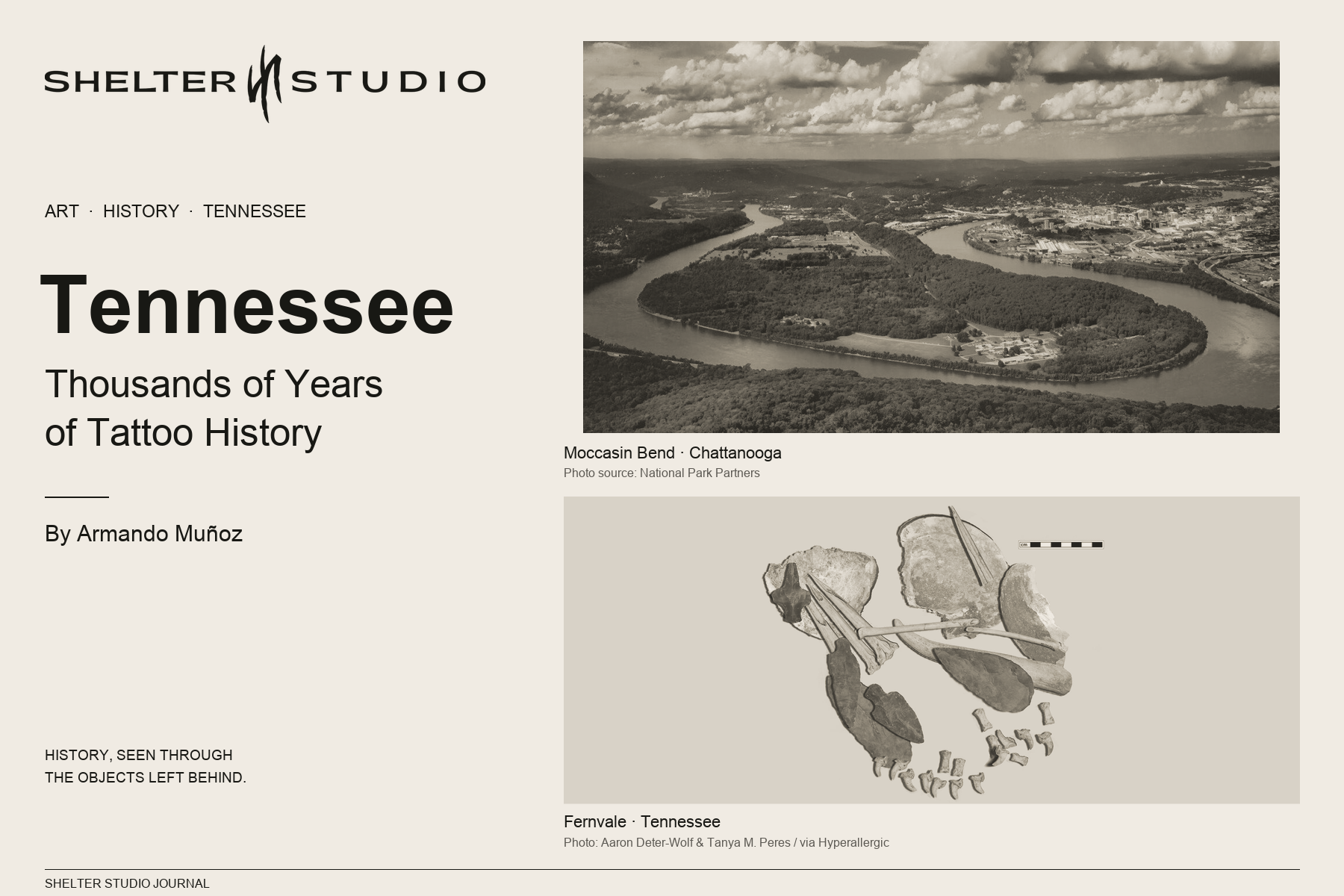
During an excavation in 1985 beside the South Harpeth River, archaeologists recovered several modified turkey bones. At first glance, they could have appeared to be ordinary awls, tools used to pierce materials.
Decades later, a study published in 2021 examined their surfaces through microscopy and analysis of wear patterns and residues. Two sharpened turkey bone tools showed wear consistent with tattooing. The assemblage also contained traces of black and red pigments.
The researchers conservatively estimated the burial and its associated tools to date to 3500 to 1600 BCE. This is an approximate range, not an exact date for the tools. Their analysis supports the use of these implements for tattooing thousands of years ago. Read the Fernvale study.
Why does Tennessee matter?
Skin rarely survives for millennia. Exceptions such as Ötzi, the “Iceman,” allow researchers to observe ancient tattoos directly on a body. Elsewhere, tools help reconstruct their history. South Tyrol Museum of Archaeology: Ötzi’s tattoos.
Fernvale shows how objects once considered ordinary implements can reveal a specialized practice when their wear, pigments, and context are studied together. Aaron Deter-Wolf, affiliated with the Tennessee Division of Archaeology, is the first author of the 2021 Fernvale study, alongside Tanya M. Peres and Steven Karacic.
The tools do not tell us which designs people wore or what those designs meant to them. They do provide evidence of the knowledge and materials used to create permanent marks on skin.
Chattanooga within this history
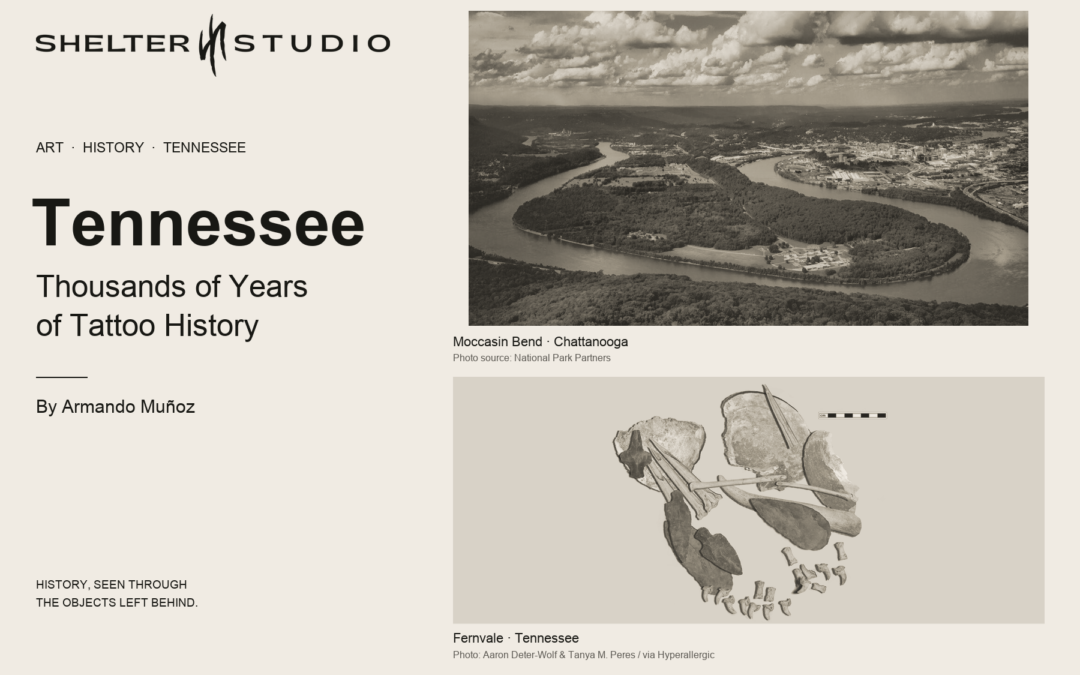
Fernvale is in central Tennessee, not Chattanooga. For local historical context, Moccasin Bend preserves approximately 12,000 years of human history, with evidence from different periods of Indigenous occupation. It offers context for the region’s deep history, although it does not, by itself, demonstrate that tattooing took place there. National Park Service: Moccasin Bend.
Today, tattooing continues to find new forms of expression in Chattanooga. Shelter Studio is part of that present, welcoming guest artists from different parts of the world and bringing their specialties to clients in Tennessee.
Recognizing the Fernvale findings invites us to look more deeply at tattooing: a practice with a long human history, whose techniques and meanings have varied across cultures and continue to evolve.
Sources and image credits
- Ancient Native American bone tattooing tools and pigments: Evidence from central Tennessee. Journal of Archaeological Science: Reports, 2021.
- South Tyrol Museum of Archaeology: Milestones in Ötzi Research.
- National Park Service: Moccasin Bend National Archeological District.
- Landscape photograph: National Park Partners.
- Fernvale photograph: Aaron Deter-Wolf and Tanya M. Peres, via Hyperallergic.